
The curriculum is designed to expose residents to the full range of topics, experiences, technical procedures and concepts relevant to emergency medicine that will prepare them to meet our residency’s educational goals. It's divided into clinical (on- and off-service rotations), didactic (conference, lecture, small groups, simulation), and literature-based curricula (required readings and scholarly activities).
Our residents also have protected time to attend weekly conference and lecture series every Wednesday from 8AM to 12PM. Presentations are given by varied speakers including emergency medicine faculty and residents, staff from other specialties, and local and national guest speakers. The last hour of conference is dedicated to small group and simulation-based learning. Residents are divided into 4-5 groups and will participate in:
| DIAGNOSTICS | ORAL BOARDS | ULTRASOUND | SIMULATION | EVIDENCE-BASED MEDICINE | WELLNESS |
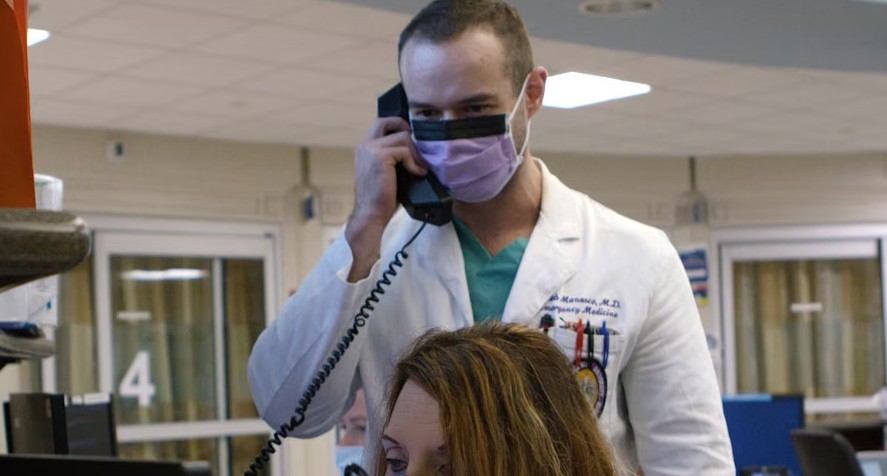
"I really love this program because of the people and the learning environment. The attendings really push you to be your best, but are always there if you need them. My fellow residents are really close and we would do anything for each other."
CALEB MANASCO, MD
Alumni, Class 2021
ROTATIONS
PGY-1
Interns start off July with one month of orientation involving ACLS/ATLS training, high-yield lectures, simulations, and plenty of procedure and ultrasound practice. There is a total of four 4-hour "shadow shifts" at the main ED at OLOL during the month as well. This is designed to help ease our new residents into the ED workflow, seeing different pathologies, using EPIC, and getting to know everyone! There is always close supervision with upper-level residents and attendings. The EMS rotation allows residents to experience and appreciate the pre-hospital care provided by our first responders in the field. Throughout the year, interns are encouraged to see as many critical patients as they're comfortable with and perform procedures including intubations, central lines, chest tubes, reductions, and many more. Interns have 3 weeks of vacation for the year.
6 months ADULT EM
(4) OLOLRMC & (2) BRGMC
1 month ULTRASOUND/EMS
OLOLRMC & EBR Parish EMS
2 months PEDIATRIC EM
OLOL Children's Hospital
1 month LABOR & DELIVERY
Woman's Hospital
1 month ADULT MEDICAL ICU
OLOLRMC or BRGMC
1 month ORIENTATION
OLOLRMC, LSU MEIC Sim Center
PGY-2
Second-year is focused on helping residents manage multiple patients, become more efficient in the ED workflow, and supervising and teaching interns. PGY-2's are expected to run all level 1 and level 2 traumas, initiate appropriate medical/trauma resuscitations, and assist PGY-1's with any procedures. During ICU months, they will have plenty of opportunities to learn how to care for critical patients and are expected to act as code leaders. Second years have four weeks of total vacation.
7 months ADULT/PEDIATRIC EM
(5) OLOLRMC & (2) BRGMC
1 month PEDIATRIC ICU
OLOL Children's Hospital
1 month TRAUMA ICU
OLOLRMC
1 month EM/TOXICOLOGY
OLOLRMC/OLOL Children's Hospital
2 months ADULT MEDICAL ICU
(1) OLOLRMC & (1) BRGMC
PGY-3
As third years, residents are encouraged to act as junior level attendings, managing multiple patients while supervising lower-level residents and medical students. One final ICU month allows residents to hone in on their critical care skills before hitting the real world. Finally, third years have the opportunity during their elective month to focus on those areas of emergency medicine that are most important to them. Popular choices include ultrasound, toxicology, research or a teaching elective. Third years have four weeks of vacation time.
9 months ADULT/PEDIATRIC EM
(7) OLOLRMC/OLOLCH & (2) BRGMC
1 month ELECTIVE
Choose from established rotations, including Acting/Teaching Attending, Ultrasound, Toxicology, EMS, ICU, Cardiology, Peds Anesthesia, ENT, Sports Medicine or Research
1 month QI/TEACHING
OLOLRMC
1 month ADULT MEDICAL ICU
BRGMC